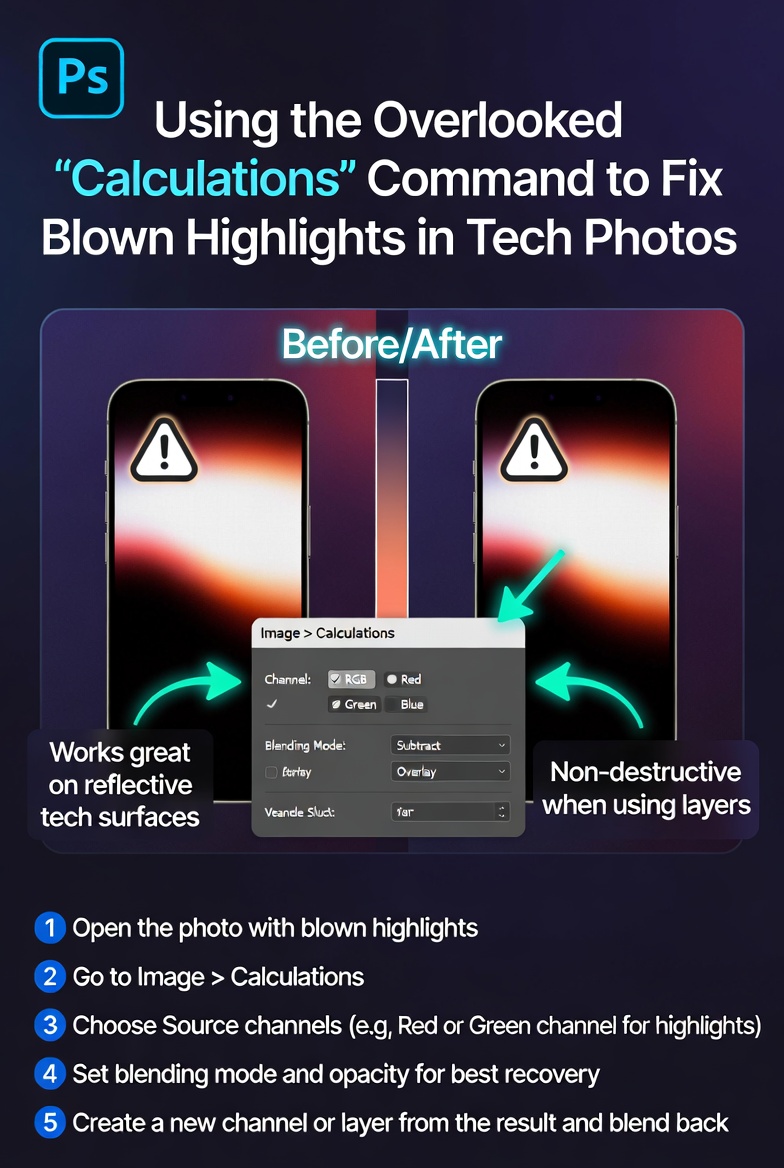
Using the Overlooked “Calculations” Command to Fix Blown Highlights in Tech Photos
The phenomenon of blown highlights is a prevalent problem in the field of technology photography, particularly when photographing shiny surfaces such as screens, metal finishes, or glossy gadgets under intense illumination sources. It is common for these overexposed regions to lose all of their detail, which results in photographs that seem imbalanced and less formal. In spite of the fact that many users depend on fundamental tools like brightness or exposure changes, Photoshop has a capability that is far more complicated and much less used, and that is the “Calculations” command. It is possible to mix channels and make exact choices based on tonal data using this tool, which makes it a very useful tool for restoring highlight detail. The use of Calculations enables photographers and designers to zero down on certain portions of a picture that need improvement and make adjustments to those areas without impacting the overall image. Product photography, user interface displays, and high-contrast technology images are all areas in which this method provides very useful results. By gaining an understanding of how to properly use this function, you may improve the efficiency of your editing process and generate outcomes that are cleaner and more polished.Comprehension of Blown Highlights in the Field of Technology Photography
The phenomenon known as “blown highlights” takes place when some regions of a picture are overexposed to the point that the details are entirely destroyed. The presence of powerful reflections on screens, metallic surfaces, or bright LED elements is a common cause of this phenomenon in the field of technology photography. It is common for these regions to have a completely white appearance, with no discernible texture or information. Following the clipping of highlights, it becomes difficult to restore detail using the conventional correction tools. It is at this point that more sophisticated editing methods, such as channel-based editing, come into play. Through the process of evaluating the color channels of a picture, it is often possible to discover concealed tonal information that may be of assistance in reconstructing highlight regions. It is necessary to have a thorough understanding of the nature of blown highlights before attempting to fix them using any procedure.
What Constitutes the Calculations Command in Its Complete Form
In Photoshop, the Calculations command is a powerful function that allows you to generate a new alpha channel or selection by blending together two channels. Additionally, it enables you to mix tone information from many channels by using blending modes, which ultimately results in masks that are quite precise. When it comes to isolating certain tonal ranges, such as highlights or shadows, this approach is considered to be extremely beneficial. Calculations offers a more nuanced and configurable way to masking, in contrast to the simple selection options that are available now. It is possible for users to target just the troublesome portions of a picture by producing accurate choices by themselves. Because of this, it is an excellent tool for repairing blown highlights without having an impact on the rest of the composition.
The Process of Getting Your Image Ready for Channel-Based Editing
It is essential to ensure that your picture is correctly prepared before attempting to use the Calculations command. Let us begin by making a copy of your first layer so that you may save the original version for future reference. The next step is to investigate each of the distinct color channels in order to determine which one has the highest level of information in the regions that reflect light. In many cases, one channel will be able to store more information than the others, which makes it a more suitable candidate for an amalgamation. Another way to improve the visibility of features inside the channels is to make a minor adjustment to the contrast. In order to guarantee that the Calculations process generates a mask that is both precise and usable for highlight correction, proper preparation is required.
Determining the Highlight Mask Through the Use of Calculations
In order to correct blown highlights, the objective is to construct a mask that separates the portions of the picture that are lightest in color. When you use the Calculations command, you have the ability to mix channels in a manner that gives more emphasis to highlight areas while reducing the amount of midtones and shadows. Experimenting with different blending modes, such as multiply or screen, allows you to fine-tune the mask so that it only targets the parts that are super exposed. A selection may then be loaded using the alpha channel that was produced as a consequence. This selection serves as a precise border via which modifications may be applied, so guaranteeing that corrections are restricted to the areas that are under the influence. The fact that Calculations provides such a great level of control is what makes it such an effective tool for highlight rehabilitation.
The process of applying targeted adjustments in order to recover detail
Following the creation of the highlight mask, you will be able to make modifications that are targeted in order to restore detail and balance exposure. Adjustment layers, such as curves or levels, allow you to lessen the brightness of the specified regions while simultaneously reintroducing contrast to those areas. It is not possible for these alterations to have an effect on the remainder of the picture since the mask only isolates the highlights. This tailored method makes it possible to make tiny adjustments while yet preserving a natural appearance. It is possible to further enhance the results by combining numerous correction layers, which will progressively reconstruct detail in areas that have gone overexposed. When compared to global modifications, which sometimes result in photos that are too flat or lifeless, this approach is far more exact.
Methods for Increasing the Quality of Results Through Layer Blending
It is possible to further improve the recovered highlights by using layer mixing methods after the application of fundamental fixes. It is possible to achieve a seamless integration of the corrected regions into the picture by adjusting the opacity of the layer or experimenting with different blending styles. Performing this step guarantees that the modifications will have a natural appearance and will not result in any apparent transitions or artifacts. Enhancing the overall appearance of the mask by using feathering or soft brushes to make adjustments may also be beneficial. These approaches enhance the final picture by adding an additional layer of refinement, which results in the image seeming polished and professional. When it comes to creating high-quality results, paying close attention to the details throughout this stage is essential.
How to Avoid Making Common Errors When Utilizing Calculations
Calculations is a powerful command, but if it is not handled wisely, it may be abused and utilized in inappropriate ways. Selecting the incorrect channels is a typical error that may lead to masks that are either inefficient or inaccurate. Excessive processing of the picture, including the application of forceful changes, might potentially result in artificial outcomes. When working on anything, it is essential to take things slowly and assess the changes at each stage. Ignoring the need to improve the mask is another problem that might result in unequal adjustments or sharp edges. By avoiding these problems and keeping a disciplined approach, users may get consistent and dependable outcomes when correcting blown highlights.
Techniques of the Highest Professional Standard for Editing Production
Combining the Calculations command with other Photoshop tools allows for the creation of processes that are even more complex, and this is only available to more experienced users. It is possible to get even better results by using techniques such as luminosity masking, frequency separation, and selective color grading. Through the integration of these technologies, one is able to exert a higher degree of control over the tonal balance and detail recovery. When it comes to future projects that have lighting circumstances that are comparable, keeping bespoke masks for reuse may help speed up the process. Through the mastery of these sophisticated approaches, photographers and designers are able to manage even the most difficult highlight difficulties with accuracy and efficiency, resulting in the production of high-end images that are fit for use in professional circumstances.