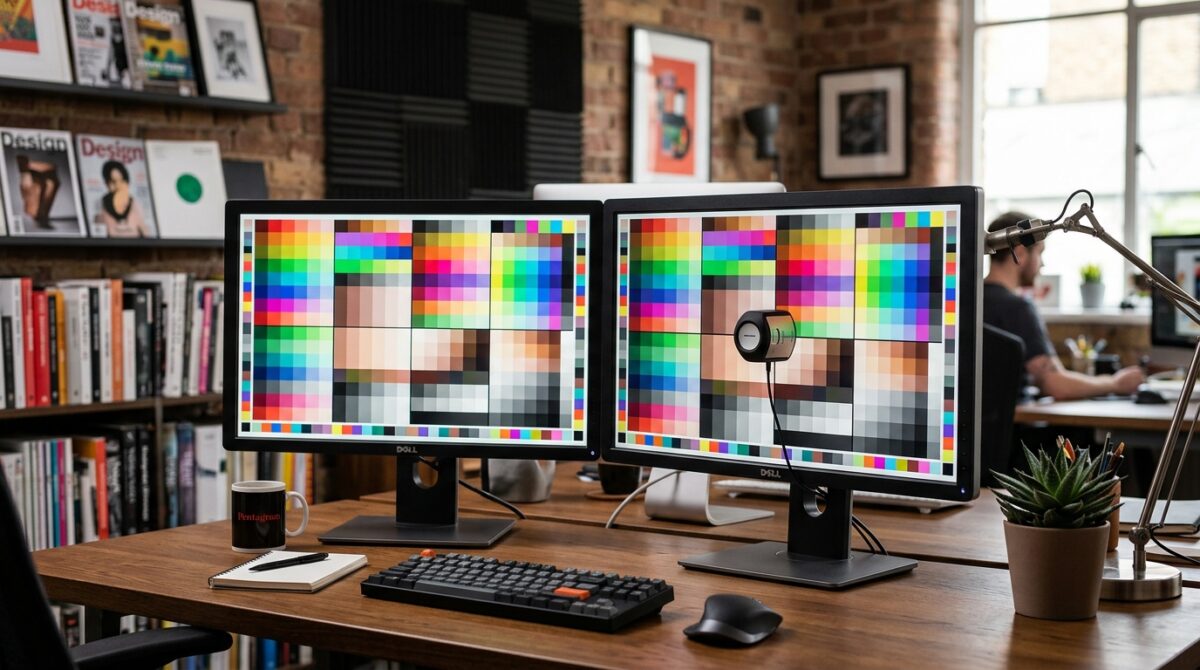
Managing OS-Level ICC Color Profiles to Achieve Exact Color Matching Across Dual Monitor Setups
When it comes to professional digital work, one of the most problematic parts is achieving accurate color reproduction across two monitor setups. This is particularly true in situations that include design, photography, and video editing. In spite of the fact that two monitors are similar in model, the colors that they show are often different. This is because to variances in panel calibration, differences in factory calibration, and aging components. When dealing with color-critical projects, where accuracy is of the utmost importance, these irregularities become much more visible. A formal method for standardizing the manner in which colors are interpreted and shown across a variety of displays is provided by the International Color Consortium (ICC) color profiles at the operating system level. Users have the ability to greatly eliminate color incompatibilities and provide a more consistent visual experience by correctly establishing and maintaining these profiles. In order to get results that are reliable and predictable, it is vital to have a solid understanding of how ICC profiles interact with the operating system color management system. Bringing twin monitor setups considerably closer together in terms of visual consistency is possible with the right calibration and profile assignment.
Acquiring Knowledge of the ICC Color Profiles and Their Function
ICC color profiles are standardized data files that have the purpose of describing the manner in which a device reproduces color. The brightness, contrast, and color temperature of each monitor are not the same since each monitor has its own set of properties. By mapping colors into a reference space that is constant, ICC profiles are able to correct for these variations. This guarantees that the values that are presented on the screen are more closely aligned with the values that are meant to be produced. Prior to transmitting color data to each display, the operating system makes use of these profiles in order to understand colors. Each monitor may have a different interpretation of the identical color values if it does not have the appropriate profiles. It is essential to color management that you have a solid understanding of this translation process. Users are able to exercise control over the graphical representation of colors across a variety of devices. When it comes to bridging the gap between hardware diversity and visual consistency, ICC profiles are the bridge.
Adjusting the calibration of each monitor prior to assigning profiles
Prior to the application of ICC profiles, it is necessary to calibrate each monitor appropriately in order to create a baseline. Calibration is the process of altering the brightness, contrast, gamma, and white balance of an image so that it is in line with a target standard. This procedure guarantees that both displays begin from a reference point that is consistent with one another. It may be possible to employ hardware calibration tools or built-in display settings, depending on the availability of the equipment. In the absence of calibration, ICC profiles are incapable of producing correct findings. It is important to calibrate each monitor independently under illumination conditions that are comparable. This lessens the impact of the surrounding environment on perceiving distinctions in hue. In order to achieve successful color matching, accurate calibration is the building block. This guarantees that any modifications made to the profile are both relevant and dependable.
The process of assigning ICC profiles at the level of the operating system
It is necessary to apply ICC profiles using the color management settings of the operating system once the displays have been calibrated as necessary. Each display has the capability of having its own specialized profile, which allows for the interpretation of colors to be defined. In order to guarantee that applications and system elements make use of the appropriate color mapping, it is necessary to assign profiles at this level. It is the operating system’s responsibility to apply these profiles automatically when rendering. Because of this, there is no longer a need for applying manual modifications inside specific programs. Having the right assignments in place guarantees uniformity across the whole procedure. Additionally, it enables the operation of color adjustments from a centralized location. When it comes to preserving consistency across two displays, this step is really necessary. There is a clear correlation between accurate profile assignment and visual accuracy.
Gaining an Understanding of the Gamut Differences Between Displays
The number of colors that a monitor is able to reproduce is proportional to the color gamut that it supports, which might vary from monitor to monitor. While some displays are capable of supporting basic color ranges, some are capable of covering broader gamuts for example Adobe RGB or DCI-P3. In situations when two displays have differing gamuts, it becomes more difficult to match colors for accuracy. The mapping of colors into a common space is one of the ways that ICC profiles assist to reduce these discrepancies. On the other hand, it is not possible to completely remove physical hardware constraints. It is helpful to have reasonable expectations for color matching when one is aware of the variances in gamuts. Additionally, it serves as a reference for making judgments about monitors for professional usage. It is possible to increase uniformity by matching color capabilities as nearly as feasible. Gaining an understanding of the gamut is necessary for successful color management.
Making Certain That Brightness and White Balance Are Consistent
Differences in brightness and white balance may produce noticeable mismatches, even when the ICC profiles utilize the proper values. It is possible for one monitor to look warmer or brighter than another, even if the colors on both monitors are theoretically exactly the same. Making these adjustments manually helps bring the two displays closer together in terms of their visual appearance. When working side-by-side, it is very crucial to ensure that the brightness levels are same. It is also necessary to change the white balance to the same reference point. These changes are complementary to the use of ICC profiles. Your attempts to match colors will be less successful if the brightness is not constant. The precision of colors and the uniformity of brightness are both essential components of visual harmony. The correct modification will result in a viewing experience that is more consistent.
Incorporating Profiles Across a Number of Different Applications
It is possible that several apps will handle color management in a different manner, which may have an impact on consistency. In order to achieve precise rendering, professional software often makes use of inbuilt ICC profiles. Certain apps, on the other hand, may choose to disregard or just partly implement system-level settings. When attempting to fix discrepancies, it is essential to have a solid understanding of how each program handles color. Improvements in accuracy may be achieved by enabling color management within suitable software. Establishing and maintaining consistency across processes is facilitated by ensuring that apps are set appropriately. This is of utmost significance in working situations that include design and editing. When it comes to color accuracy, application-level behavior has a direct effect. Configuration done correctly guarantees that system-level profiles are exploited to their maximum potential.
A Guide to Avoiding the Most Common Color Management Errors
There are a number of frequent errors that might diminish the efficiency of the ICC color management strategy. Implementing the factory’s default settings without first calibrating them will result in inconsistent outcomes. Incorrectly assigning profiles to screens may result in a substantial distortion of colors. Failure to take into account variances across monitors leads to visual output that is not consistent. Failure to recalibrate over a period of time permits drift to build up. Users should adhere to a calibration and profiling procedure that is organized in order to prevent these concerns. Maintaining accuracy requires doing verification on a regular basis. It is possible to avoid misconfiguration by understanding each step. It is very necessary to pay close attention to detail in color-critical operations. It is possible to get more reliable outcomes by avoiding these blunders.
The Maintenance of Color Consistency Over the Long Term
Accuracy in color is not a one-time setting but rather a process that occurs continuously. As time passes, monitors undergo changes as a result of age and environmental influences. Recalibration on a regular basis guarantees that ICC profiles will continue to be correct. Keeping profiles up to date is an effective way to establish uniformity across dual monitor configurations. It is also important to maintain a consistent level of environmental illumination in order to prevent fluctuations in perception. Keeping a record of the calibration settings makes it easier to generate consistent results. Upkeep over an extended period of time guarantees that the color accuracy will not deteriorate. Maintaining consistency requires both a correct setup and consistent maintenance. Taking this strategy guarantees consistent visual performance throughout the course of time.